Powderpost beetle remediation targets three primary wood-boring families: Lyctidae (true powderpost beetles), Anobiidae (deathwatch and furniture beetles), and Bostrichidae (false powderpost beetles). In older…
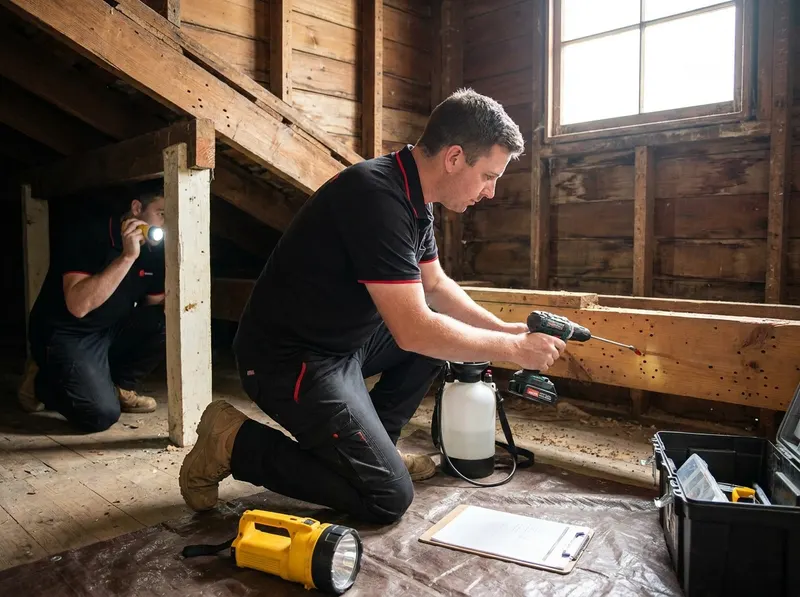
Powderpost beetle remediation targets three primary wood-boring families: Lyctidae (true powderpost beetles), Anobiidae (deathwatch and furniture beetles), and Bostrichidae (false powderpost beetles). In older Cincinnati housing stock throughout Over-the-Rhine, Walnut Hills, and Clifton, unsealed heartwood beams and mixed-species joists often date back to the late 19th century. Lyctid larvae attack large-pore hardwoods like oak and ash when moisture levels exceed 12%, consuming the interior starch matrix and reducing structural wood into a fine, flour-like frass. In stone-foundation crawlspaces across Northside and College Hill, higher ambient relative humidity allows Anobiid beetles to thrive in softwood sill plates and pine subfloors. Remediation halts larval tunneling by applying a liquid borate salt solution directly to the bare wood. The chemical diffuses into the cellular structure of damp timber, neutralizing the larvae as they ingest the fiber without releasing synthetic pyrethroid fumes into living areas above.
Active structural remediation requires differentiated decision-making based on timber exposure and frass morphology. While superficial pest spray products only coat the wood exterior, larvae can remain feeding deep within structural timbers for 1 to 5 years before emerging through 1/16-inch to 1/8-inch exit holes. If the wood exhibits fresh, clean frass, resembling unbaked flour without cobwebs, the infestation is active and requires direct liquid borate diffusion or pressurized deep-void injection. If exit holes are dark and weathered with packed, oxidized debris, the damage may be historical and non-active, requiring moisture stabilization rather than chemical intervention. For sealed or finished woodwork in locations like Mount Adams or Mount Lookout where borate cannot penetrate paint or polyurethane, technicians either strip the finish to expose bare pores or isolate individual structural members for localized non-spray temperature or injection protocols.
Structural intervention follows a five-step containment and saturation protocol to ensure permanent defense against reinfection:
Moisture management dictates whether beetles can re-infest treated wood. Lyctid beetles cannot digest wood starch when wood moisture drops below 8%, and Anobiid larvae perish when framing dries below 10% to 12%. Basements and stone-foundation cellars near the Ohio River basin and low-lying parts of Hyde Park or Oakley require persistent relative humidity controls below 50%. Building safety directives outlined by the Occupational Safety and Health Administration govern how technicians enter confined crawlspaces to address structural pests. Property owners evaluating crawlspace moisture should cross-reference guidance from the International Association of Certified Home Inspectors to differentiate insect exit channels from fungal decay. Long-term structural timber codes are managed through the American Wood Protection Association, while regional environmental remediation follows pesticide rules established by the Ohio Department of Agriculture. Ashmere Insect Solutions establishes treatment barriers that remain bonded to the wood fiber indefinitely, preventing adult beetles from re-depositing eggs on treated timber surfaces.
Every job gets a firm, written price after an on-site visit.
Tell us about your powderpost beetle remediation job in Cincinnati and we'll send a clear, written quote, usually the same day.
 Ashmere Insect Solutions