Ashmere Insect SolutionsAshmere Insect Solutions

Seasonal Exterior Perimeter Pest Defense Cincinnati

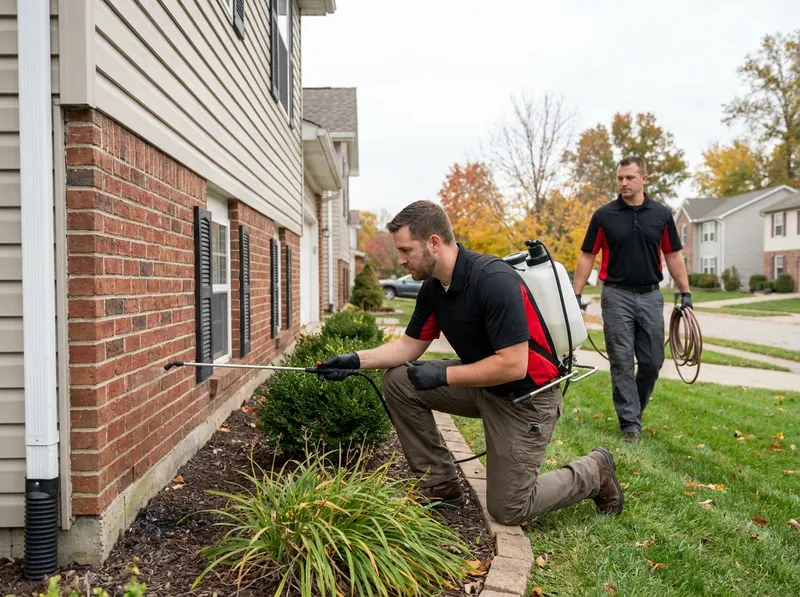
Seasonal exterior perimeter pest defense in Cincinnati establishes a persistent 3-foot by 3-foot chemical and physical boundary along building foundations to block seasonal migrations into residential housing. In…
Get My Estimate →(513) 812-8078
Seasonal Exterior Perimeter Pest Defense in Cincinnati, oh
Quick answer
  • Application protocol: Exterior foundation micro-injections, liquid residual bands 3 feet up and 3 feet out, and mechanical crack seals; interior application excluded unless specified.
  • Target pests: Odorous house ants, brown marmorated stink bugs, American cockroaches, boxelder bugs, silverfish, and subterranean ground beetles.
  • Pricing baseline: Foundation treatments start at $200 for standard urban perimeters, with exact fees confirmed on-site before service starts.
  • Service cadence: Quarterly deployment scheduled across spring, summer, fall, and early winter to align with Midwest pest migration cycles.
  • Contact point: Dispatch scheduling operates through direct phone intake at (513) 812-8078.

Seasonal exterior perimeter pest defense in Cincinnati establishes a persistent 3-foot by 3-foot chemical and physical boundary along building foundations to block seasonal migrations into residential housing. In historic districts containing dense brick rowhomes such as Over-the-Rhine and Walnut Hills, settling lime mortar joints create high-risk avenues for odorous house ants (*Tapinoma sessile*) and oriental cockroaches (*Blatta orientalis*). Ashmere Insect Solutions directs structural exterior applications to the masonry ledger board, basement window wells, weep holes, and the soil-to-foundation interface. Regulated under standards maintained by the Ohio Department of Agriculture, modern barrier programs incorporate localized macro-encapsulated micro-emulsions and pyrethroid alternatives that bind directly to coarse masonry without running off into storm basins governed by the United States Environmental Protection Agency. The operational choice prioritizes external interception: exterior mechanical exclusion eliminates the intrusive requirement for indoor prep, furniture shifting, and baseboard chemical placement within living areas, though it does not eliminate existing wood-destroying organism colonies located deep inside wall cavities without supplemental drilling.

Subterranean insects and overwintering invaders exploit specific regional architectural vulnerabilities found in older timber-frame foundations in Clifton, Northside, and College Hill, as well as expansive slab properties throughout Hyde Park, Oakley, and Mount Lookout. Ground vegetation, mulch layers against exterior brick, and rooflines abutting mature tree canopies in neighborhoods near Mount Adams and Pleasant Ridge guide outdoor populations directly toward uncaulked service penetrations. Research published by the Ohio State University Extension documents how ambient temperature drops in late September trigger mass migrations of brown marmorated stink bugs (*Halyomorpha halys*) and western conifer seed bugs toward sun-facing siding. Applying perimeter micro-treatments to eaves, soffits, and mechanical pipe chases before seasonal drop thresholds minimizes pest pressure without oversaturating residential turf.

Technicians deploy low-impact active compounds evaluated through the National Pesticide Information Center database, ensuring formulations bond dry within 60 minutes to prevent residue transfer to domestic pets or non-target wildlife. Structural defense adheres to commercial containment criteria outlined by the National Pest Management Association and workplace safety directives from the Occupational Safety and Health Administration. Environmental integration corresponds to urban watershed safeguards coordinated by the City of Cincinnati and seasonal public health alerts overseen by the Centers for Disease Control and Prevention. Comprehensive exterior mitigation protocols adhere to standard residential property care principles reinforced by the U.S. Department of Housing and Urban Development.

    Step 1: On-site physical exterior assessment of foundation mortar, utility entry penetrations, and perimeter foliage clearance. Step 2: Mechanical clearance of loose debris, spider webs, and soil drift along the 3-foot perimeter zone. Step 3: Application of targeted residual micro-barrier formulation to the exterior foundation wall up to 36 inches above ground level. Step 4: Deposition of targeted granular botanical or low-impact barrier bands across soil, gravel, or mulch borders 36 inches outward from the structural base. Step 5: Sealing of accessible foundation penetrations under 0.5 inches using elastomeric silicone compounds to prevent structural entry.

How much does Seasonal Exterior Perimeter Pest Defense cost in Cincinnati?

Urban Rowhouse Foundation (up to 1,500 sq ft exterior footprint, e.g., Over-the-Rhine)$200 - $285
Standard Detached Home Perimeter (1,500 - 2,500 sq ft footprint, e.g., Oakley, Northside)$225 - $360
Large Detached Estate Perimeter (2,500 - 4,000 sq ft footprint, e.g., Hyde Park, Mount Adams)$320 - $495
Quarterly Perimeter Maintenance Program (Per Treatment, 4 Seasonal Cycles)$200 - $275

Every job gets a firm, written price after an on-site visit.

Common questions

What pests does seasonal exterior perimeter pest defense target in Cincinnati?
The barrier treatment targets perimeter ground pests including odorous house ants, pavement ants, ground beetles, centipedes, millipedes, earwigs, silverfish, and seasonal invaders such as brown marmorated stink bugs and boxelder bugs common to Cincinnati residential zones.
Is exterior perimeter application safe for pets and children around Cincinnati homes?
Treated exterior foundation bands dry completely within 60 to 90 minutes under typical Cincinnati relative humidity conditions, after which the active micro-encapsulated residuals remain bound to substrate surfaces without air drift or ground transference.
Does exterior pest defense eliminate the need for indoor chemical spraying in Cincinnati?
Exterior boundary exclusion intercepts over 80% of seasonal crawling insects at the structural envelope, eliminating the requirement for broad indoor aerosol or baseboard spraying in homes unless an entrenched nesting colony is already active inside sub-flooring.
How frequently should a Cincinnati property receive perimeter barrier treatments?
Quarterly treatments spaced 90 days apart provide continuous exclusion across Cincinnati, maintaining barrier integrity against spring ant emergences, mid-summer crawling insects, autumn overwintering shelter-seekers, and early-winter ground pest movements.
What preparation is required from Cincinnati homeowners prior to exterior defense applications?
Homeowners must clear exterior foundation perimeters of hoses, dog toys, outdoor decor, and stored wood piles, while ensuring perimeter landscaping, mulch, and groundcover are trimmed back at least 12 inches from exterior masonry.

Get started today

Tell us about your seasonal exterior perimeter pest defense job in Cincinnati and we'll send a clear, written quote, usually the same day.

Get your PEST CONTROL SEVICE quote, Cincinnati

We only use your ZIP to check availability, no spam.